
Published by Crushing & Screening Ltd | Thirsk, North Yorkshire | crushingandscreening.co.uk
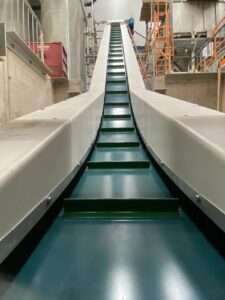 If your conveyor belt keeps drifting to one side, running off its rollers, or causing unexpected downtime, you’re not alone. Belt tracking problems are one of the most common issues reported by operators across the quarrying, recycling, waste processing, and bulk materials industries — and they can be genuinely frustrating to diagnose and fix.
Here at Crushing & Screening Ltd, we’ve been designing, manufacturing, and maintaining conveyor systems from our North Yorkshire workshop since 1985. In this guide, we’ll walk you through the most common causes of belt tracking problems, the principles behind correct belt tracking, and the range of solutions available — from simple pulley adjustments through to fully automatic belt control systems.
Key takeaway: In most cases, belt tracking problems are caused by the installation — not the belt itself. Poorly aligned pulleys, inadequate tracking measures, or faulty design are the most common culprits.
Understanding Why Conveyor Belts Track Off Centre
A conveyor belt running over perfectly cylindrical pulleys, aligned at exact right angles to the belt’s direction of travel, will experience forces that are entirely parallel to its running direction. In theory, no sideways tracking force is applied — but this also means the belt is in a state of unstable equilibrium.
In practice, the slightest disturbance — off-centre loading, a build-up of dirt on a roller, a small amount of belt distortion, or material being fed in laterally — is enough to cause the belt to drift. Once it starts moving sideways, it will continue to run toward the side with the least tension.
Tracking Rule #1: The belt tracks towards the side with the least tension.
The same problem occurs when one or both pulleys are not positioned accurately at right angles to the belt’s running axis. The belt will always migrate toward the less-tensioned side, so even minor misalignment during installation can lead to persistent tracking issues.
Before attempting any tracking adjustments, three fundamental conditions must be in place:
- The supporting structure must be rigid and stable, capable of withstanding belt tension, the weight of conveyed material, and uneven floor conditions.
- All pulleys and rollers must be fitted at right angles to the belt running axis. Adjustable components should only be adjusted after the belt has been properly run in.
- All parts that contact the belt — pulleys, rollers, slider beds — must be kept clean and protected from dirt and material build-up.
Basic Belt Tracking Measures: Crowned & Cylindrical-Conical Pulleys
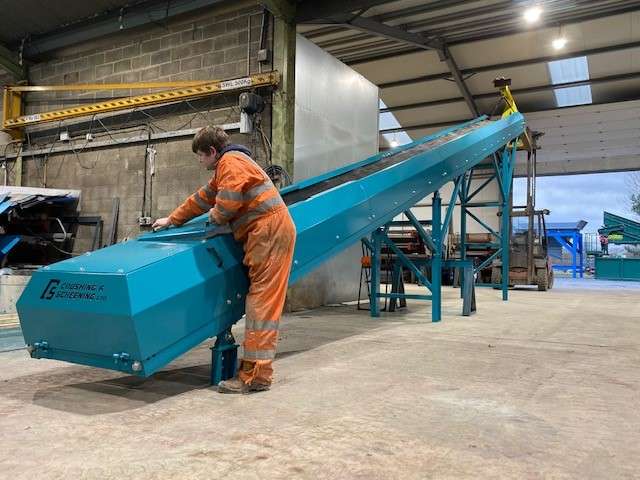
For the majority of conveyor installations, the most effective and reliable basic tracking measure is to fit at least one pulley — and often more — with a cylindrical-conical or radially crowned profile. This is standard practice on fabric belt conveyors and in most applications will be sufficient on its own to achieve straight, stable running.
A crowned pulley exerts a self-tracking effect on the belt, automatically centering it without the need for axis adjustment. This works even when there are variable run-off tendencies or changes in running direction.
On simple two-pulley conveyors with a fixed running direction, it’s typically the head (drive) pulley that is crowned. However, on longer conveyors — particularly those with a length-to-width ratio greater than 5:1 — and on reversing installations, it’s advisable to crown both the head and tail pulleys.
Additional Belt Tracking Measures: When Crowned Pulleys Aren’t Enough
In installations with pronounced run-off tendencies, significant transverse forces, or complex belt paths, crowned pulleys alone may not provide sufficient tracking control. In these cases, additional measures are required — and the right choice will depend on the specific application and operating conditions.
 1. Guiding Pulleys (Control Pulleys)
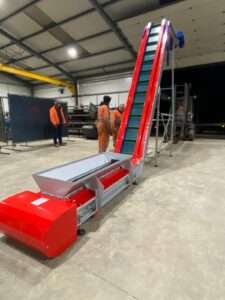
Guiding pulleys — also known as control pulleys — are adjustable snub pulleys, typically cylindrical in form. To achieve effective tracking, the arc of contact at a guiding pulley should be a minimum of 30°. The tracking effect can be further improved by adding a friction cover in abrasion-resistant rubber or synthetic material (Shore A hardness of 80–90 is recommended).
Tracking Rule #2: The larger the arc of contact and the higher the friction, the greater the tracking effect.
One important point: unlike crowned pulleys, adjustable cylindrical guiding pulleys are not self-tracking. This means they must be manually reset when the belt’s running direction changes, which makes them generally unsuitable for reversing operations — unless the conveyor is long enough to allow adequate separation between guiding pulleys.
Tracking Rule #3: In a group of pulleys and rollers, the one the belt first makes contact with has the greatest tracking effect.
2. Inclined Rollers on the Return Side
Inclined rollers fitted to the return side of the belt are a highly effective tracking measure, particularly for wide, short belts and for thin belts running at high speeds. For best results, they should be positioned on the run-on side — in front of the tail pulley for head drives, or in front of the driving pulley for tail drives.
For a satisfactory tracking effect, the belt should contact the roller over approximately a quarter of the belt’s width, and the angle of incline should be between 5° and 10°. When rollers are fitted exactly at right angles to the belt’s running direction, the belt will self-correct if the run-off tendency changes — and this method works in reversing operations too.
Note: if the rollers are angled forward by 8–10° in the running direction, the tracking effect is enhanced — but this configuration must not be used in reversing applications, as the centering forces will reverse along with the belt direction.
3. Guiding Profiles
Guiding profiles — typically V-shaped rubber or synthetic sections welded or glued onto the running side of the belt — are best used to counteract localised transverse forces rather than as a general tracking solution. They’re particularly useful in areas where materials are fed from the side or diverted, creating brief lateral forces on the belt.
Due to higher production costs and limitations at high speeds (where profiles can be forced out of their grooves), they’re not recommended as a primary tracking measure. As a general principle, the belt should always be tracked by conventional means first — with guiding profiles used only in the specific zone where transverse forces occur.
4. Automatic Belt Control Systems
For the most serious or persistent belt tracking problems — or in critical applications where manual intervention isn’t practical — automatic belt control offers a comprehensive solution. It is, however, the most expensive option and should be considered only when other methods have proved insufficient, or where chronic contamination of rollers and pulleys makes manual adjustment impractical.
Automatic belt control systems work by sensing the position of the belt’s edges — using optical, pneumatic, electrical, or mechanical sensors — and sending a signal to a control mechanism that adjusts a guiding pulley to re-centre the belt.
A practical tip: it’s advisable to equip one side of the guide/control roller with a standard manual adjustment device, so the tracker assembly can be initially aligned by hand before the automatic system takes over. The automatic control should be left in the neutral position while this manual alignment is carried out.
On installations using automatic belt control, we also recommend making the tail pulley cylindrical — a cylindrical-conical tail pulley can create a conflict between the two regulation systems, leading to erratic belt behaviour.
Special Case: Tracking Wide, Short Belt Conveyors
Conveyors where the belt width equals or exceeds the conveying length present particular tracking challenges. Thin belts with low lateral stiffness are especially prone to buckling or folding at high speeds, making crowned pulleys potentially counterproductive. In these situations, both the head and tail pulleys should be cylindrical and installed with absolute precision — perfectly parallel and square to the running direction.
Recommended additional measures for wide, short conveyors include:
- Inclined rollers on the return side (inclination of typically 5–10°, and in some applications up to 45°).
- Centre drive configuration, particularly for reversing operations.
- Guiding profiles — effective for lower-speed applications with sufficient belt transverse rigidity.
- Consider running multiple narrower belts in parallel, or switching to a plastic modular belt — a common alternative for short, wide conveyor applications.
Conveyor Belt Tracking Design Checklist
Use this checklist when designing or troubleshooting a conveyor installation to avoid the most common belt tracking problems:
- Is the conveyor structure rigid and stable enough to withstand all loads without distortion?
- Are bearings on highly stressed pulleys (head, tail, tension, deflection) made adjustable?
- Is there at least one cylindrical-conical or radially crowned pulley?
- Is the crown height of crowned pulleys correct and in line with manufacturer recommendations?
- Has it been considered that the first pulley in the belt’s running direction has the greatest tracking effect — and been made adjustable accordingly?
- Are snub rollers made adjustable so they can be used for belt tracking?
- Have all standard tracking methods been considered before resorting to guiding profiles?
- If guiding profiles are used, are groove dimensions correct — narrow where transverse forces occur, wider elsewhere?
- Are all possible measures in place to keep belts, pulleys, rollers and slider beds clean?
Need Help With Your Conveyor System?
Crushing & Screening Ltd has been designing, building, and maintaining conveyor systems for the quarrying, recycling, and materials processing industries since 1985. Whether you’re experiencing belt tracking problems, looking to upgrade an existing system, or need a bespoke conveyor solution designed from scratch, our team in Thirsk, North Yorkshire is here to help.
We offer:
- Bespoke conveyor design and manufacture
- On-site installation, servicing, and repairs
- Spare parts and maintenance support
- New and quality pre-used equipment
- Hire and finance options